Cladding
About the necessity of cladding
The usability of industrial insulation for one or another purpose and under a diverse range of conditions does not depend solely on the insulation properties of these materials, but also on the choice of the right cover material. Quite often (in some industries, e.g. paper, chemical, food, energy industry, etc.), equipment is used in a moist and chemically aggressive environment. Many pipes, equipment’s, storage tanks, etc. are located outside, thus being influenced by all of the accompanying environmental impacts. Even interior temperatures may fluctuate quite a bit and indoor climate in procuction facility may sometimes be even worse than outside conditions. All of the above, along with a number of other environmental factors, have an effect on insulation properties and longevity.
The mechanical properties of the insulation cladding are also important in many cases: resistance to compression, tension, bending, vibration, impact, hardness of the cover, etc.
Consequently, it is important to choose the right cladding material.
Today, sheet metal is one of the most commonly used cladding materials in industrial engineering insulation. Generally, flat sheets are used to cover pipes, equipment, and smaller tanks insulation, profiled sheets are mainly used on flat or nearly flat surfaces, such as large storage tanks, boilers, industrial electrical filters, etc. Exceptional cases, fireproof fabrics, foil, plastic materials, etc., are used as cladding materials.
Cladding is used:
1. to protect insulation from mechanical damage;
2. to protect insulation from the weather conditions, including:
against corrosion caused by moisture; against insulation embrittlement due to UV radiation; against particles flying in the wind, causing the depreciation of the surface layer (erosion);
3. to protect insulation from corrosion caused by an industrial corrosive environment;
4. to allow for the insulation to be more easily cleaned, allowing a good 6th level of hygiene to be maintained, e.g. in the food industry;
5. to prevent dust arising from the insulation material;
6. to be able to change the appearance of the insulation and adapt it to the architectural whole.
When choosing cover materials, their properties and usage options in different environments must be considered pursuant to given conditions. It should not be forgotten that the support structures and fasteners of insulation cover materials are significant for the insulation as a whole.
Some examples:
It must be taken into account that heat bridges, solar and other heat radiation may significantly increase the surface temperature of cover plates. In case of fire, the temperature of a cover plate rises significantly, thus there is a reason to avoid using aluminum sheet metal as a cover plate in places with increased fire risk.
CLADDING MATERIAL
Depending on the place of use and the purposes, cover plates are made from different materials. The most common materials are:

Galvanized steel sheets (usage temperature 200 °C / -60 °C)
Galvanized steel sheets are used in situations where there are no specific requirements for the surface covers. The thickness of the zinc coating is 275 g/m2–350 g/m2. The material stands out in terms of its strength and hardness, notable resistance to corrosion, and low cost. The melting point of zinc is 420 °C. At a high temperature of 900 °C, the zinc layer ignites and burns with a bright flame. The burning process emits poisonous zinc oxide, the inhalation of which may result in poisoning. The zinc salts that emerge when zinc is exposed to acid (even the weakest acids that can often be found in our food: sorrel, rhubarb, apples, etc.) are extremely poisonous; therefore, the use of galvanized sheets in the food industry is prohibited. The useful life of galvanized sheets depends on the depreciation of the zinc layer, which, depending on the surrounding environment, is an average of 0.6–1.2 micrometer’s per year, thus the zinc layer has a useful life of 20–40 years. In seaside areas, swimming pools, etc. the depreciation is already 2.1–4.2 micrometer’s per year.
Stainless and acid-resistant steel (usage temperature 800 °C / -200 °C)
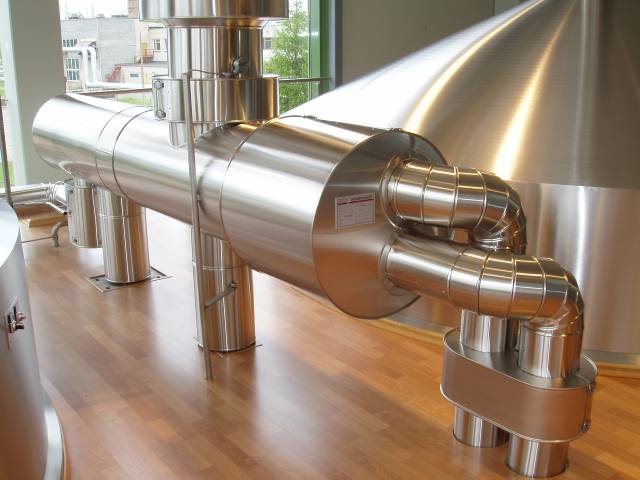
Cover Cladding materials from stainless (RST; AISI 304) and acid-resistant (HST; AISI 316) steel are used for extremely difficult environmental conditions, in which hot galvanizing no longer provides a sufficient surface treatment to inhibit corrosion. The main areas of use are the chemical, paper, and food industry enterprises. In addition, these products are used in places with increased hygiene requirements, e.g. the medical industry. Stainless steel is an invention of the 20th century. It is a metal alloy, consisting of different components. Some of them are metals, but are not classified as such, for instance, carbon. The main component is iron, the binding components are chromium and nickel, the purpose of which is to prevent corrosion, i.e. the erosion or rusting of the metal surface.
The term ‘stainless steel’ can only be used if the chromium content of the steel is greater than 12%. Chromium prevents corrosion of the steel surface because chromium creates a thin protecting oxide layer on the surface. The greater the chromium content, the better the resistance to corrosion. The nickel in the stainless steel also ensures corrosion-resistance. Choosing either an RST or HST product depends on several different factors. The most important of these is the content and concentration of different chemicals in the surrounding environment. As a general rule, acid-resistant HST products are better for industrial conditions and seaside locations, while their resistance in chloride-containing environments is also better.
Aluminum sheet (usage temperature 300 ° / – 60 ° C)
Aluminum has a number of good properties (e.g. good corrosion resistance, low density) that make it an extremely useful coating material. Aluminum is very active towards oxygen and the fresh surface of the metal oxidizes rapidly. Only a few atomic layers of a dense oxide layer are formed, which protects the surface from further corrosion.
Advantages compared to zinc sheet: better resistance to acidic environments, no sparks from friction or impact, weight one-third of galvanized sheet, more pleasing appearance.
Disadvantages: not suitable as a covering material for fire insulation (melting point 620°C), requires more careful handling in the manufacture of parts, mechanically more easily damaged and structurally weaker than steel, greater sheet thickness must be used to achieve the same strength, more expensive than steel.
PVC-covered hot galvanized steel (usage temperature 100 °C / -60 °C)
Surface cover based on polyvinylchloride. Exceptionally workable material. Does not withstand UV radiation well; however, excellent corrosion resistance even in the most difficult environmental conditions in industrial and seaside areas.
PVDF-covered (PVF 2) hot galvanized steel (usage temperature 110 °C / -50 °C)
Surface cover based on polyvinyl difluoride. A surface cover with exceptional color-resistance, which is why we recommend the use of PVDF surface covering in case color resistance is important. Disadvantage: prone to scratches.
Colour coated hot galvanized steel (usage temperature 100 °C / -60 °C)
Colour coated flat steel products are made from previously galvanized and coloured steel sheets. The products are suitable for use in interiors with a low moisture level and in other places where the environmental impact level is light use in mainly clean air.
Main paints colour coatings:
- POLYESTER – polyester paint, which gives the products good weather, corrosion, and abrasion resistance.
- PURAL – paint coating based on polyurethane, withstands ultraviolet radiation exceptionally well, is also easy to process at low temperatures, and is chemically stable.
- PVDF – Polyvinyl chloride based surface coating. First-class colour shade long-last durability
As an exception, other metals are also used to cover steel sheets: copper, tin, aluminum-zinc, etc.
Read more: What is good insulation? | Rock wool | Polyurethane | Stainless steels | Calculators |